- Fire Door Remedials
Call Us Anytime!
Our team is always ready to pick your call and help you.
01670 331788
Fire Door Remedial Works Carried Out to Restore Fire Resistance and Prevent the Spread of Fire and Smoke Through Compartment Lines
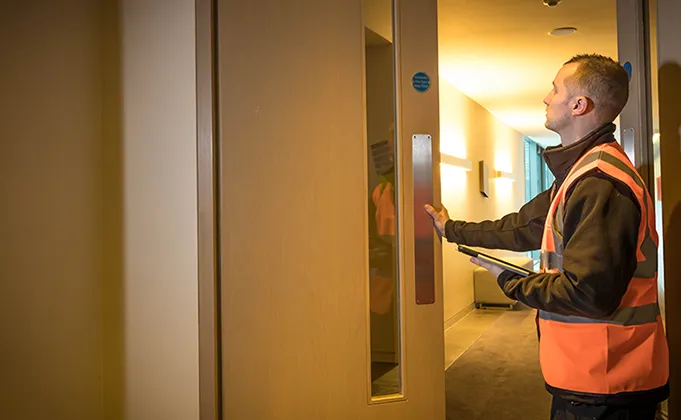
We start every remedial programme by validating the inspection report — re-surveying a sample of doorsets to confirm the reported defects and identifying anything missed. From there, we work through the remediation schedule in priority order: fire-critical defects first (gap excesses, missing intumescent, broken closers), then secondary defects (signage, vision panel failures, hinge issues), then finishing.
Where a doorset cannot be safely remediated — typically because the leaf is non-certified, the frame is structurally damaged, or the original installation was so far outside the tested scope that no repair will restore the rating — we replace the full doorset and certify it from new.
Our Capability Includes
- Intumescent and smoke seal replacement
- Gap adjustment (top, sides and threshold)
- Hinge replacement and uplift
- Closer upgrade and adjustment
- Vision panel re-glazing and certified replacement
- Door leaf and frame repair within tested tolerances
- Lock, latch and access control upgrades
- Signage replacement to current standards
- Full doorset replacement where remedial work is unviable
- Closing report with before/after photographs of every door
Our Delivery Process
Frequently Asked Questions
Can every failed fire door be remediated?
Ans. Most can. Around 80–90% of inspection failures we see are minor and remediable. The remainder usually need full doorset replacement because the leaf is non-certified or the frame is too damaged to bring back into tested tolerance.
Will remedial works invalidate the original certification?
Ans. Only if the remedial is carried out outside the doorset’s tested scope. That’s exactly why remedials should be done by a Q-Mark-accredited installer using manufacturer-approved components.
How quickly can you mobilise a remedial programme?
Ans. Typically within ten working days of instruction for smaller schemes and two to three weeks for larger programmes requiring resident liaison or out-of-hours access.